Listening
How to listen to fado, first time
A short listening guide for your first fado concert: what the Portuguese guitar answers, what the viola keeps, the held notes, the verse forms and saudade.
See open fado dates ↗Quick answer
Listen for a conversation. The Portuguese guitar plays the opening and then answers each line the singer gives it, while the classical guitar keeps the harmony and the pulse. The singer stretches the ends of phrases and holds notes, so the beat bends around the voice. You do not need the words; the shape of each song carries a great deal.
The opening phrase
Fado songs rarely start with the voice. In the Lisbon style, English Wikipedia explains, the guitarra plays an introduction traditionally based on the second half of the vocal melody. In other words, the guitar quietly tells you the tune before the singer arrives. Listen to that first phrase and try to hold it in your head; when the singer comes in, you will hear the melody you were just given, now carried by a voice and words.
Call and response
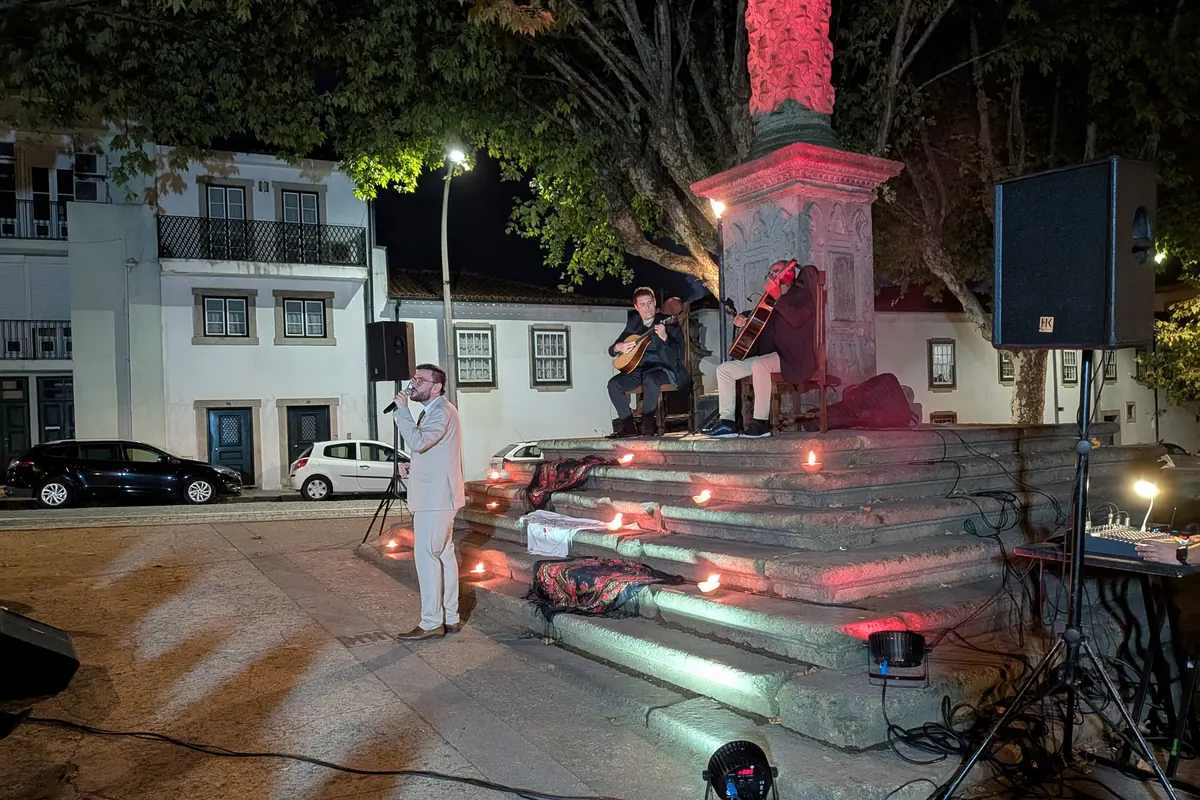
Once the singing starts, the Portuguese guitar does not simply accompany. It answers. Between the singer’s lines it plays short, expressive phrases, a musical call and response, and in faster songs it may weave around the voice throughout. The classical guitar, the viola, holds everything together underneath with chords and rhythm. A good habit for a first concert is to follow the guitarra for one whole song, then the singer for the next, and notice how differently the same piece sounds.
The held note
English Wikipedia names rubato as a particular trait of fado: at the end of a phrase the music pauses while the singer holds the note for dramatic effect. This is why fado can feel as if it breathes rather than marches. The guitarists follow the singer, not a fixed count, and wait for the voice before moving on. Fado also slides from major to minor and back, now and then inside one song, and those shifts often land on a word the singer wants you to feel.
Verses and themes
Fado is sung poetry. The Fado Museum notes that its poetry is cast in quatrains, five- and six-line stanzas, ten-syllable lines and alexandrines, and that its subjects run from love and luck to a person’s fate and the city’s everyday story, often alert to social injustice. Early fado lyrics were mostly anonymous and passed on by ear; from the 1950s, through Amália Rodrigues and the composer Alain Oulman, fado took up the verse of published poets. You will not catch the words without Portuguese, but you will hear the stanzas returning.
Saudade, and not only sadness
People reach for one Portuguese word, saudade, to sum fado up: a longing shot through with loss. Popular belief, Wikipedia observes, hears fado as mournful song about the sea and hard lives, yet a fado may take on almost any subject so long as it keeps to the old form. Expect some slow, aching songs and some quicker, lighter ones; a fado night is not one long lament.
Your part as a listener
In a fado room the audience is part of the sound by keeping quiet. Stay still while a song lasts, keep your glass on the table, and save applause for the final note. Between songs is the moment to shift in your seat or sip your wine. At this concert the two singers share the hour, so you can compare how a man’s voice and a woman’s voice handle the same tradition, and after the last song you can ask the musicians whatever you noticed. If a particular song stayed with you, tell them so; musicians rarely tire of hearing it.
Read next: Is this Porto fado hour worth it?
Sources